

This post opens a new series on AI. In the posts that follow, UCC Media Justice board members will take up the moral and ethical questions AI raises, both in how we use these tools and in the policies that govern them. What they write will help guide our ministry’s work on AI.
When most people hear “AI,” they think of ChatGPT and other chatbots that answer your questions. But AI is much more expansive than that. It decides what shows up in your social media feed. It helps landlords screen tenants and helps banks decide who gets a loan. Most of the time, nobody tells you it’s there.
At UCC Media Justice, we believe communications is a human right and technology has to serve the public good. Before we get to the harder questions, we need a shared vocabulary. That’s where this post begins.
AI, machine learning and generative AI
People use these terms interchangeably, but they mean different things. It helps to picture a set of nested circles, each one a smaller part of the circle around it.
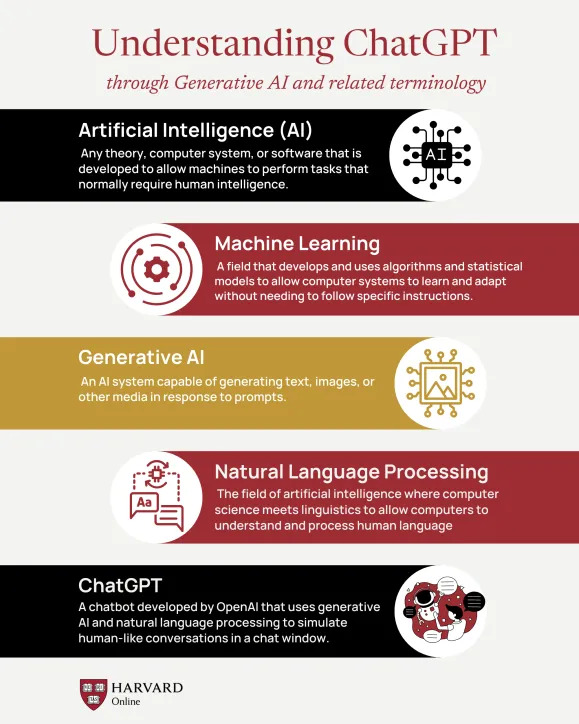
- Artificial intelligence is the outer circle. It covers computer systems that make predictions, recommendations or decisions and operate with varying levels of autonomy.
- Machine learning is a kind of AI. These systems learn and adapt without explicit instructions, using algorithms and statistical models to find patterns in data and draw inferences from them.
- Deep learning is a more advanced form of machine learning. It runs on neural networks, layers of calculations that loosely mimic how the human brain works.
- Generative AI is the newest piece, and the one everyone has been talking about since ChatGPT launched in late 2022. These tools create new content in response to a user’s prompt. The output can be text, images, music, video and more.
Harvard professor Latanya Sweeney, former chief technologist at the Federal Trade Commission, created a chart that shows how these fit together:
Why people call AI a “black box”
Older computer programs followed rules that a programmer wrote out step by step. With machine learning, programmers tell the computer to make associations, and the computer decides how. Even the people who built a system often can’t explain how it reached a particular answer. That’s why people call these models a “black box.”
This is a justice problem. When an automated system labels someone too risky to rent an apartment or get a loan, and no one can say why, that person has no clear way to challenge the decision. And when a system learns from data that reflects past discrimination, it can repeat that discrimination on a scale no single loan officer or landlord ever could.
How do chatbots like ChatGPT work?
Chatbots run on large language models, which learn from enormous amounts of text. At a basic level, they do one thing very well. They predict the next word in a sentence, then the next, until they’ve built an answer. This short video explains how it works:
What does it mean when AI “hallucinates”?
Because chatbots predict what sounds right instead of checking what’s true, they can be confidently wrong. When a chatbot makes something up and presents it as fact, we call that a hallucination.
In 2023, a federal judge in New York sanctioned two lawyers who filed a brief citing six court cases that ChatGPT had made up. The cases sounded real. They didn’t exist.
Treat what a chatbot tells you as a first draft, and check the facts and sources before you rely on it or share it. Be especially careful with anything you pass along on social media, where a confident falsehood can travel a long way before anyone checks it.
Who makes these chatbots?
A small number of very large companies build the most widely used AI chatbots:
- ChatGPT, made by OpenAI (CEO Sam Altman)
- Claude, made by Anthropic (CEO Dario Amodei)
- Gemini, made by Google (Alphabet CEO Sundar Pichai)
- Copilot, made by Microsoft (CEO Satya Nadella)
- Meta AI, made by Meta (CEO Mark Zuckerberg)
- Grok, made by Elon Musk’s company xAI
For more than six decades, we have fought media consolidation because whoever owns our media shapes what we see and hear. The same holds for AI. A handful of the wealthiest companies in the world are making choices about these tools that affect all of us, and the public deserves a say.
Protect your privacy when you use AI
Your conversations with a chatbot may not stay private. According to Forbes, “Potentially every conversation that you have with a tool like ChatGPT or Gemini is processed and used to train the vendor’s AI models, unless you configure your privacy settings to opt out.”
Wired magazine says it’s safest to start “with a baseline expectation of approximately zero real privacy from anyone who is determined to access your conversation records and has a legal path to obtaining them.” That can include the company itself, its business partners and contractors, law enforcement, and even someone who subpoenas the records in a civil lawsuit.
A good rule: if you wouldn’t post it publicly, don’t type it into a chatbot. That goes double for passwords, bank details and anything someone told you in confidence, like a pastoral care conversation. Check your privacy settings and opt out of training where you can.
What’s next
Our board members will take up the harder questions in the posts ahead. Some of that work has already started. Our study circle on AI data centers is gathering input from people facing those projects in their own communities. We hope you’ll wrestle with these questions alongside us.
The United Church of Christ believes every person bears the image of God and deserves fair treatment. That belief still holds when a computer makes the decision.
Follow UCC Media Justice on social media and share these posts with your friends and your congregation.