
WASHINGTON, D.C. — Dr. Ruha Benjamin, a leading scholar on race, technology, and justice, will deliver the 2026 Everett C. Parker Ethics in Telecommunications Lecture and veteran journalist Richard Prince will be recognized with this year’s Everett C. Parker Award, the United Church of Christ’s Media Justice Ministry announced today.
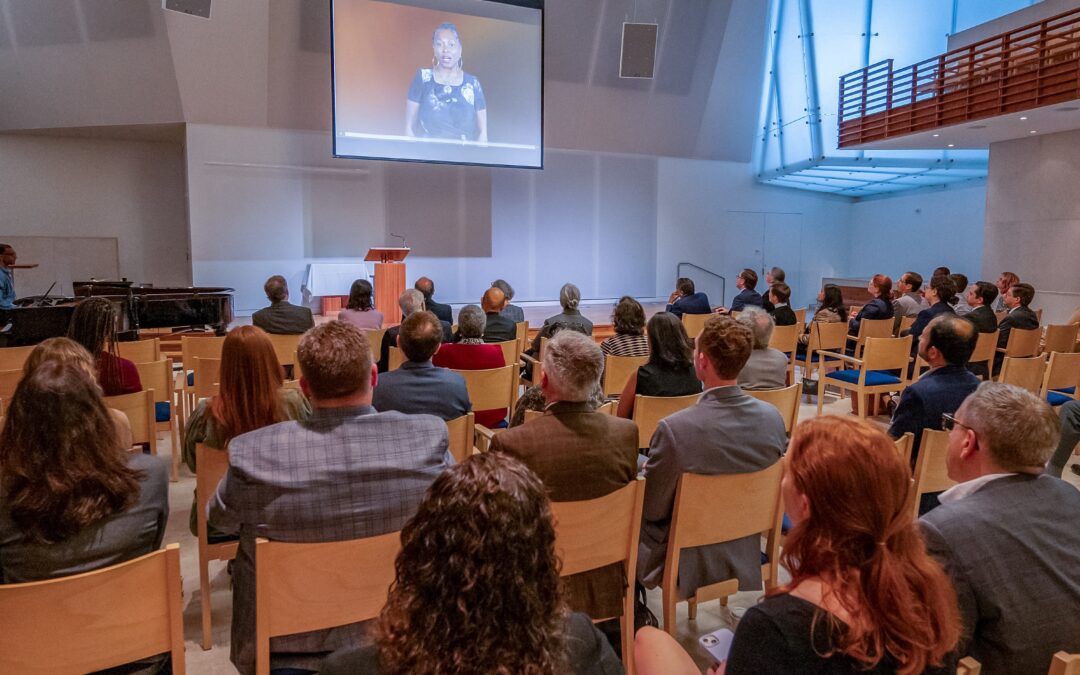
The 44th Annual Everett C. Parker Ethics in Telecommunications Lecture and Awards Luncheon will be held from 11 a.m. to 1 p.m. on Thursday, September 10, 2026, at First Congregational United Church of Christ, 945 G Street NW, Washington, D.C. The event will also be livestreamed.
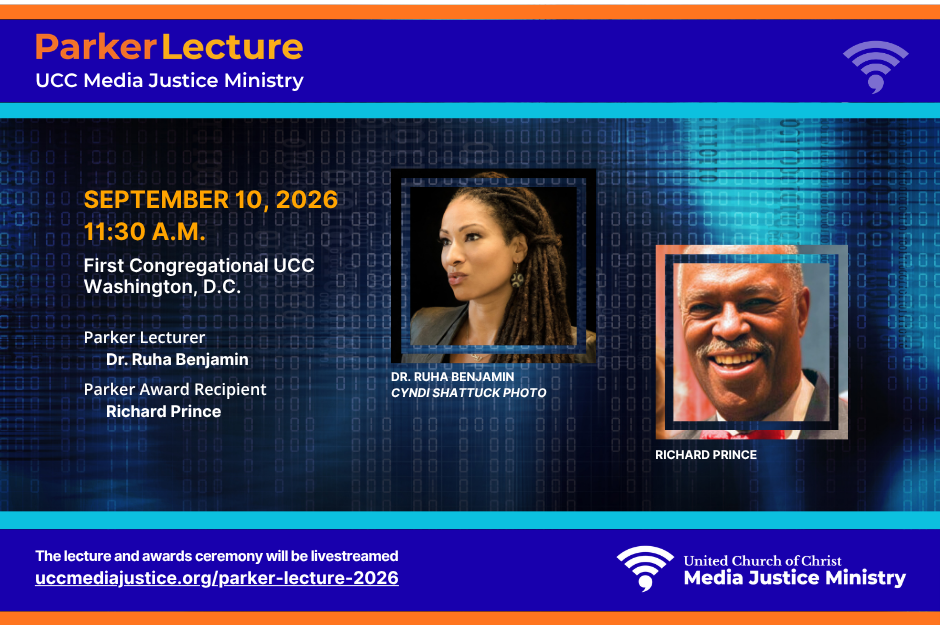
Dr. Benjamin is the Alexander Stewart 1886 Professor of African American Studies at Princeton University and Founding Director of the Ida B. Wells JUST Data Lab. In 2024, she was named a MacArthur Fellow for illuminating how technology reflects and reproduces inequality and championing the role of imagination in social transformation.
She is the author of Race After Technology: Abolitionist Tools for the New Jim Code (2019), which exposes racial hierarchies embedded in seemingly neutral algorithms and automated systems, Viral Justice: How We Grow the World We Want (2022), and Imagination: A Manifesto (2024), and the editor of Captivating Technology: Race, Carceral Technoscience, and Liberatory Imagination in Everyday Life (2019).
Through the Just Data Lab, she works with students, organizers, and artists to identify, challenge, and transform tech-mediated harms. Benjamin’s scholarship and public advocacy have brought national attention to the ways automated systems can reinforce racial discrimination. Her research sits at the center of the questions UCC Media Justice works on every day: Who benefits from new technologies, and who is harmed? What obligations do we have to ensure that the tools shaping our lives treat everyone fairly?
Richard Prince will receive the Everett C. Parker Award, given to an individual whose work embodies the principles and values of the public interest in telecommunications and the media. Prince is being recognized for decades of work holding the news industry accountable on questions of race and representation, from his early career as a member of The Washington Post’s Metro Seven to his founding of “Journal-isms,” the column he created in 1991 that monitors and reports on diversity issues in the news media.
The Metro Seven were a group of seven Black journalists who filed a landmark Equal Employment Opportunity Commission complaint against the Washington Post in 1972, challenging the newspaper’s discriminatory practices in assignments, salary, and promotions. It is believed to be the first complaint of its kind in the nation.
For more than three decades, his column has been a watchdog on the intersection of news media, race, and society. Beginning as a feature of the NABJ Journal, it grew into an independent publication read widely across the journalism industry.
As the Multicultural Media, Telecom and Internet Council has recognized, if it is important to people of color in the media, it is in “Journal-isms.” Prince was inducted into the National Association of Black Journalists Hall of Fame in 2019 and the Society of Professional Journalists’ Washington Pro Chapter Hall of Fame in 2025. He has also received the NABJ President’s Award and the Ida B. Wells Award.
Ticket information, sponsorship opportunities, livestream links, and additional details about the 44th Annual Parker Lecture can be found at https://uccmediajustice.org/Parker-lecture-2026.
About UCC Media Justice Ministry and the Parker Lecture
The UCC Media Justice Ministry is the media justice arm of the United Church of Christ denomination, which includes about 4,600 congregations and more than 700,000 members. Rev. Dr. Parker was inspired by the work of Dr. Martin Luther King Jr. to reform television coverage of the civil rights movement in the South. The advocacy of OC Inc., UCCMJM’s predecessor, resulted in the establishment of the right of all American citizens to participate before the FCC and the FCC being compelled to take away the broadcast license of the pro-segregationist television station WLBT-TV in Jackson, Miss., in 1969 for failing to serve the public interest.
The Parker Lecture was created in 1982 to recognize the Rev. Dr. Parker’s pioneering work as an advocate for the public’s rights in broadcasting. The Parker Lecture is the only program of its kind in the United States that examines telecommunications in the digital age from an ethical perspective.